
1
Branding & Labeling
Confirm any required brand name, private-label information or project-specific labeling before the order specification is finalized.
Electromagnetic and pneumatic veterinary shockwave devices use different output parameter systems and equipment configurations. For distributors, importers, OEM / ODM buyers and procurement teams, choosing between them requires more than comparing a single specification.
Electromagnetic and pneumatic systems are two different equipment technology routes. BM electromagnetic models express their confirmed output using frequency in Hz and energy in mJ, while the BM pneumatic category uses frequency together with pressure and output-level settings. Because these parameters describe different systems, their numerical values should not be compared directly as if they were the same measurement.
BM electromagnetic models use Hz + mJ as key confirmed output parameters. Individual models may differ in body design, interface, handpiece and accessory configuration.
BM pneumatic equipment uses Hz + pressure / output-level settings. Handpiece, working-head, interface and accessory details should be confirmed for the specific model.
There is no single configuration that is automatically the best choice for every buyer. A practical sourcing decision should compare output format, equipment configuration, handpiece and working-head setup, interface preferences, target market, accessories and OEM / ODM requirements.
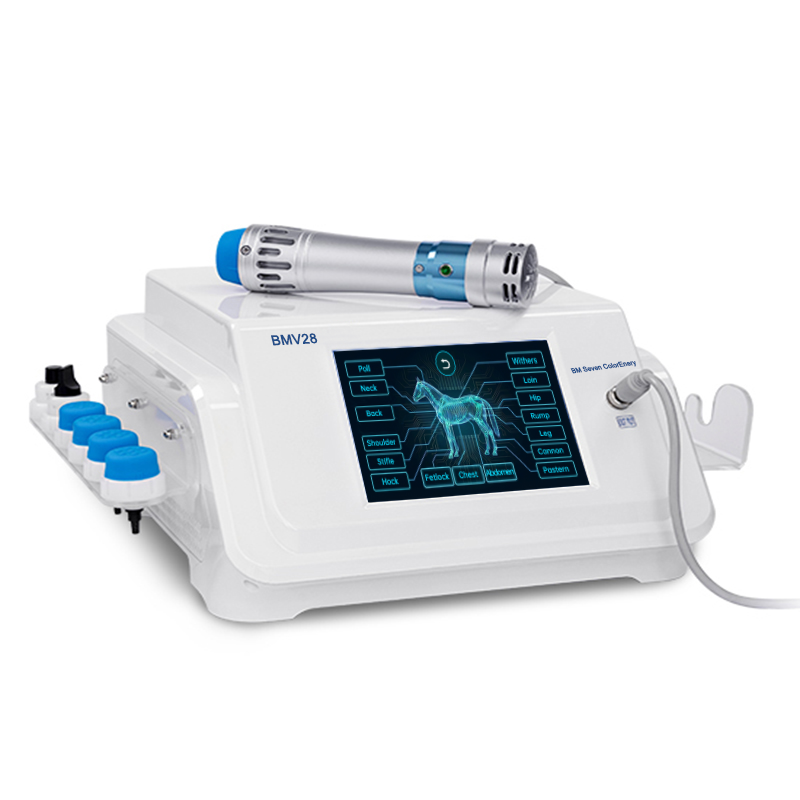
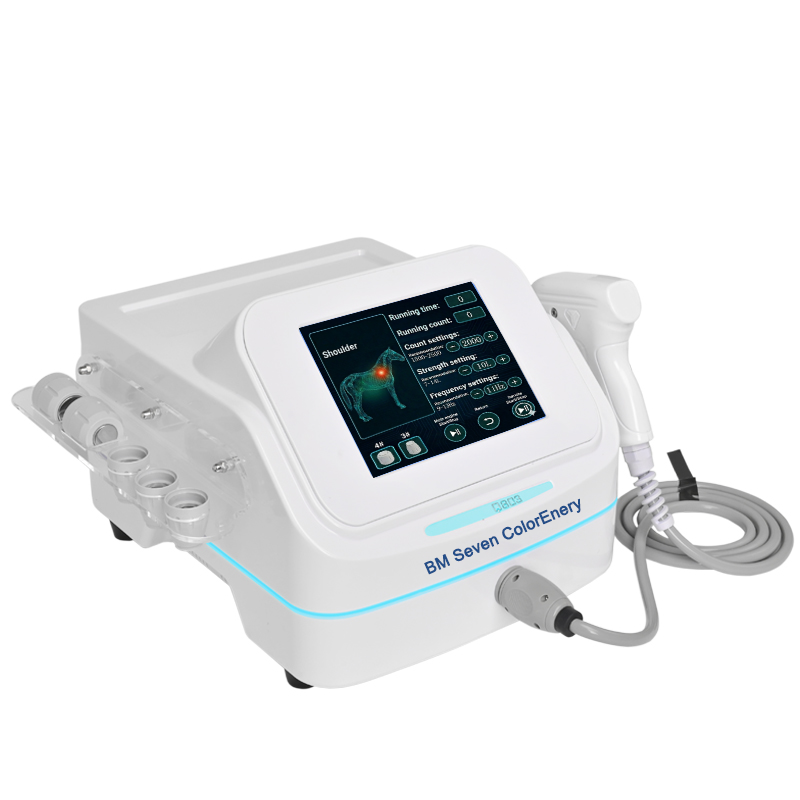
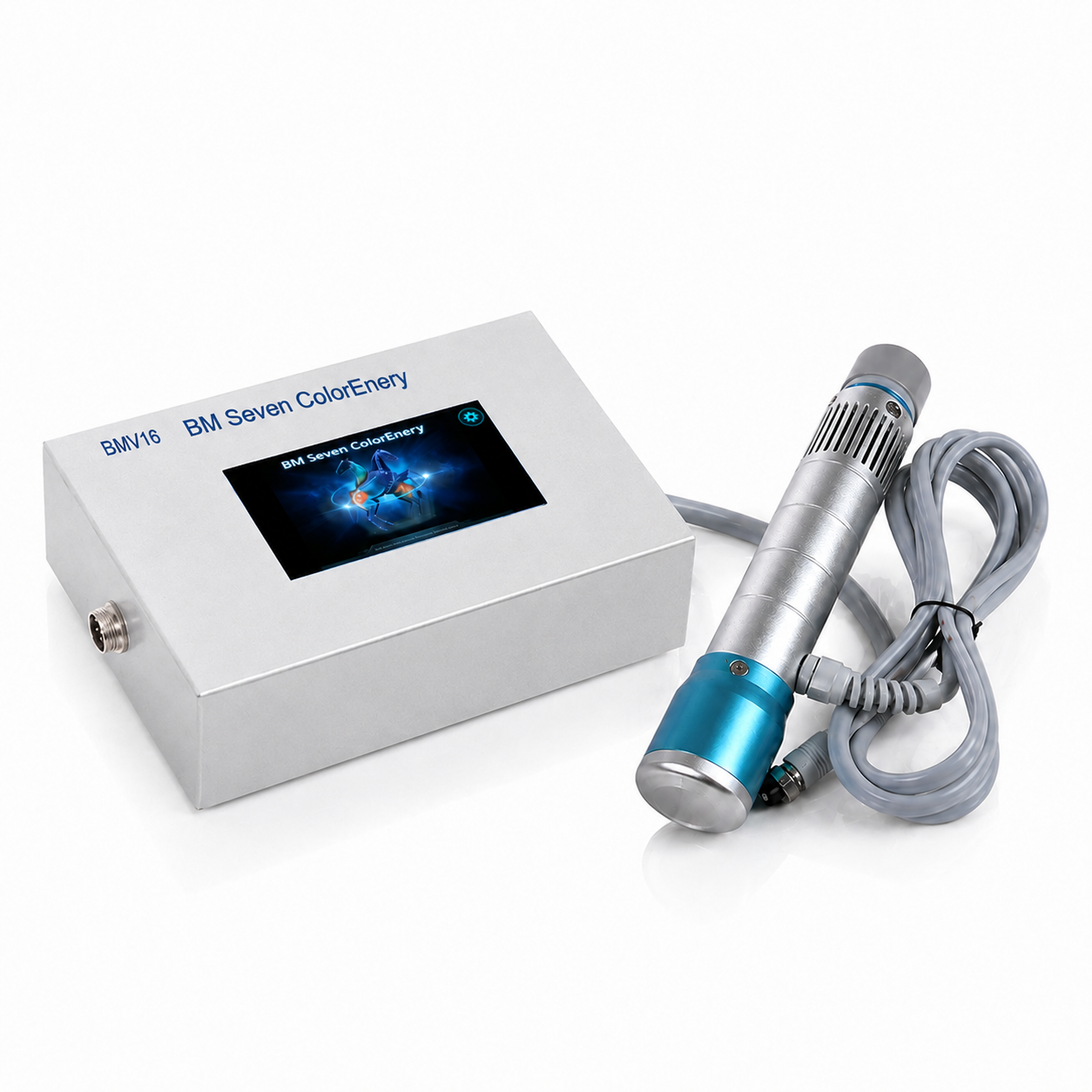
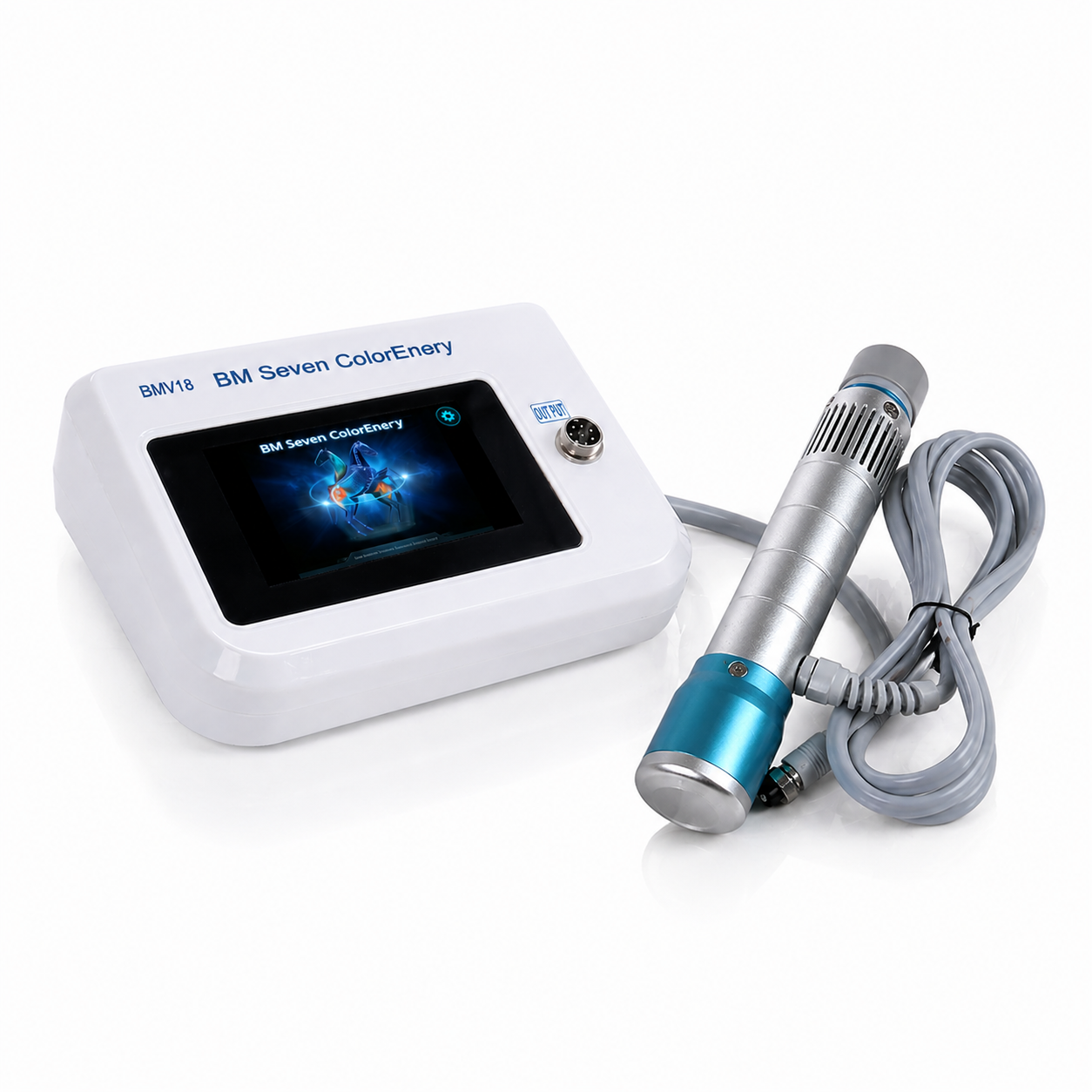
In the BM Seven ColorEnery veterinary shockwave range, electromagnetic systems use frequency in Hz and energy in mJ as key confirmed output parameters. The technology category includes several BM models, while the physical design, interface, handpiece and accessory configuration can vary from one model to another.
For equipment sourcing, an electromagnetic veterinary shockwave device should be evaluated as a complete system rather than by energy figures alone. Buyers should also review the selected model's main-unit design, control interface, handpiece, working-head configuration and supplied accessories.
BM Seven ColorEnery currently has formal product pages for BMV16, BMV18 and BMV28 as electromagnetic veterinary shockwave device examples. These models belong to the same technology category, but this does not mean that every physical or interface feature is identical across the models.
Buyers can open the individual product pages below to review model-specific configuration and sourcing details.
Buyer note: screen size, interface functions, language options, working-head quantity and other physical features should always be confirmed by model. A feature shown on one BM electromagnetic model should not automatically be assumed to apply to the entire category.
In the BM Seven ColorEnery veterinary shockwave range, pneumatic equipment uses frequency together with pressure and output-level settings rather than the mJ-based energy expression used by BM electromagnetic models. For buyers, these values should be understood within the configuration of the specific pneumatic model.
A pneumatic veterinary shockwave device should be evaluated as a complete equipment configuration. Buyers should review not only frequency and pressure settings, but also the main unit, handpiece system, working heads, control interface, electrical requirements and supplied accessories.
On the current BM Seven ColorEnery website, Q803 is the formal pneumatic model with a dedicated product detail page. Its confirmed specifications provide a real BM example of how pneumatic output settings are presented, but Q803-specific physical features should not automatically be treated as universal features of every pneumatic model.
Frequency is one of the output settings buyers can compare, but the confirmed range must be checked for the specific model.
Q803 expresses pneumatic pressure in bar, with a confirmed range of approximately 1.0–9.0 bar.
Q803 also provides numbered output-level settings. This value should not be treated as equivalent to electromagnetic mJ.
Review the dedicated Q803 page for model-specific configuration, interface, working-head, accessory and sourcing information.
Buyer note: pneumatic and electromagnetic systems use different output parameter formats. Pressure in bar, pneumatic output levels and electromagnetic energy in mJ should not be treated as directly interchangeable measurements. The complete equipment configuration should be compared before a sourcing decision is made.
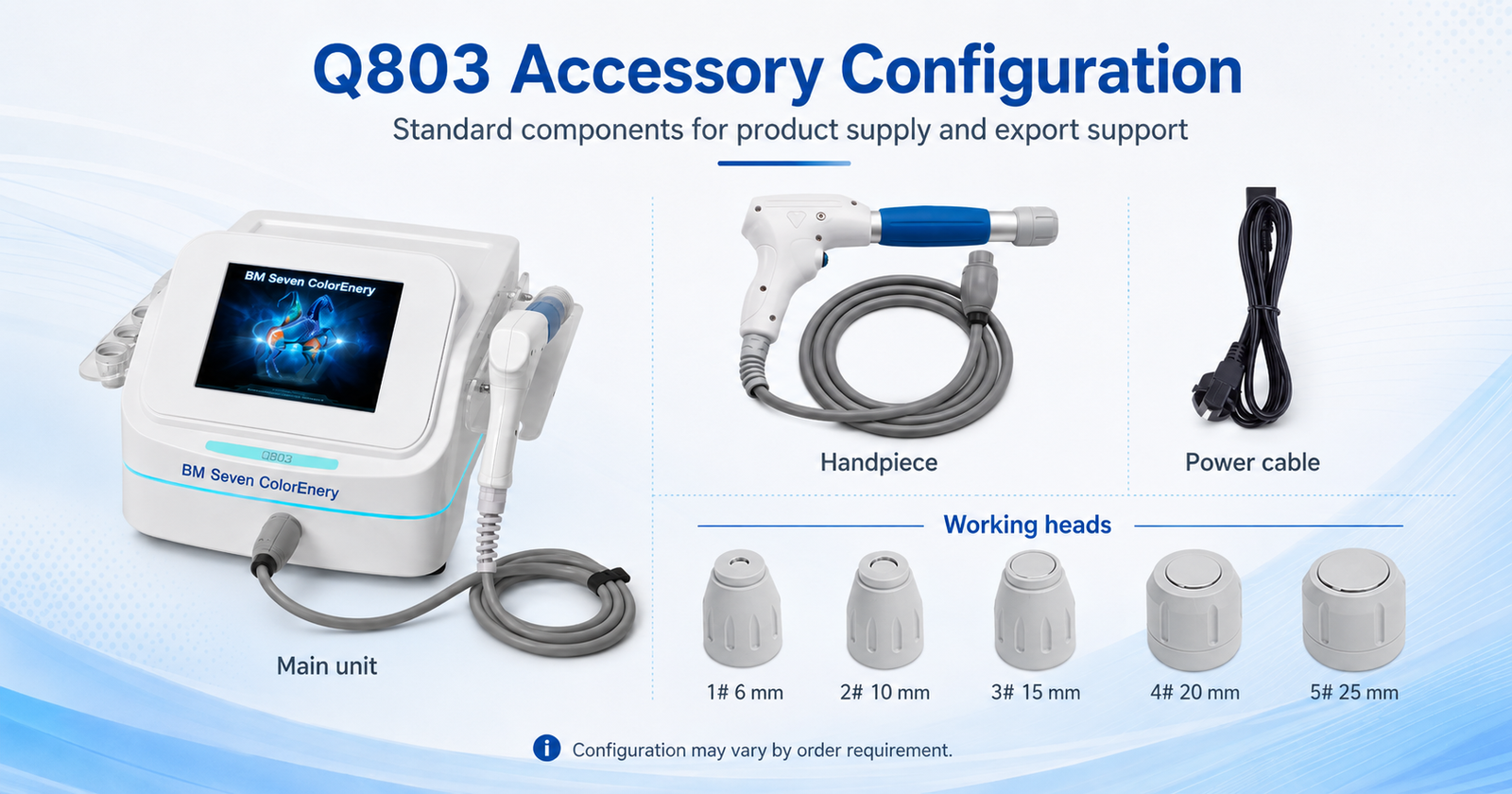
Q803 is shown here with its pneumatic handpiece and working-head configuration. Final supplied configuration should be confirmed according to the specific order requirements.
The main sourcing difference is not simply a higher or lower number. Electromagnetic and pneumatic systems use different output parameter formats and equipment configurations. Buyers should compare each technology within its own specification framework and then review the complete model configuration.
Do not compare mJ, bar and pneumatic output levels as if they were the same measurement. These values describe different system settings. A sourcing decision should consider the complete equipment configuration rather than ranking the technologies by one numerical value.
| Comparison Buyer Factor | Technology Route Electromagnetic Systems | Technology Route Pneumatic Systems |
|---|---|---|
| Output Expression | Hz mJ BM electromagnetic models use frequency and energy as key confirmed output parameters. | Hz bar output level Q803 provides a confirmed BM example using frequency, pressure and numbered output-level settings. |
| Confirmed Frequency | 1–16 Hz Confirmed BM electromagnetic range used on the current referenced models. | Q803: 1–22 Hz This is a confirmed Q803 specification and should not automatically be applied to every pneumatic model. |
| BM Website Examples | BMV16 / BMV18 / BMV28 These electromagnetic models currently have formal product detail pages. | Q803 Q803 is the current pneumatic model with a dedicated product detail page on the BM website. |
| Handpiece Configuration | Model-dependent Handpiece design and supplied configuration should be checked on the individual product page. | Model-dependent Q803 uses a pneumatic handpiece system; buyers should confirm the configuration for the selected model. |
| Working Heads | Model-dependent Type, quantity and accessory combination can vary by electromagnetic model. | Model-dependent Working-head type, quantity and final configuration should be confirmed for the pneumatic model ordered. |
| Interface & Control | Model-dependent Screen size, interface functions, languages and navigation should be checked by model. | Model-dependent Interface and control features should be confirmed from the selected pneumatic model specifications. |
| Buyer Considerations | Model selection, interface, accessories, handpiece setup, working heads and intended sourcing workflow. | Pressure and output settings, handpiece setup, working heads, interface, accessories and equipment configuration. |
| OEM / ODM | Project-dependent Availability depends on model, quantity, technical feasibility and confirmed project requirements. | Project-dependent Availability depends on model, quantity, technical feasibility and confirmed project requirements. |
Once a buyer selects the electromagnetic technology route, the next decision is the specific model and its interface, handpiece, working-head and accessory configuration.
Buyers considering Q803 should review its confirmed pressure, output-level, electrical, handpiece, interface and accessory configuration as one complete sourcing package.
Electromagnetic and pneumatic veterinary shockwave devices present their output settings differently. The units and setting formats belong to different system frameworks, so the numbers should not be treated as directly equivalent values.
BM electromagnetic models use frequency in Hz and energy in mJ as key confirmed output parameters. The currently referenced BM electromagnetic range is 1–16 Hz and 5–250 mJ.
Q803 provides a confirmed BM pneumatic example using frequency, pressure and numbered output-level settings. Its confirmed range is 1–22 Hz, approximately 1.0–9.0 bar and output levels 1–16 L.
A buyer should not look at values such as 250 mJ, 9.0 bar or output level 16 and rank them against one another by numerical size. They are not presented as the same measurement within the two equipment technology routes.
Instead, buyers should first identify which technology and output-control format matches the sourcing project, and then compare the confirmed specifications and complete configuration of the specific models being considered.
Direct answer: BM electromagnetic mJ values and Q803 pneumatic bar / output-level settings should not be directly converted or ranked against one another. They belong to different output parameter formats, so buyers should compare the technologies by their complete specifications, configuration and sourcing requirements.
Electromagnetic and pneumatic veterinary shockwave devices should be compared as different equipment configurations. For sourcing purposes, buyers should review the main unit, handpiece system and output-control approach of the specific model rather than assuming that the two technology routes use the same equipment architecture.
Main-unit design and control layout can differ between electromagnetic and pneumatic models. Buyers should verify the actual model configuration rather than assuming that similar external size or appearance means the systems are configured in the same way.
Electromagnetic and pneumatic models use different handpiece configurations. Handpiece type, connection arrangement and supplied components should therefore be confirmed from the individual product page or final order specification.
The two technology routes also present and adjust output settings differently. BM electromagnetic models use Hz and mJ, while Q803 provides a pneumatic example using Hz, pressure and output-level settings.
For BM electromagnetic models such as BMV16, BMV18 and BMV28, buyers should check the selected model's main-unit design, interface, handpiece, working heads and accessory configuration together with its confirmed Hz and mJ settings.
For Q803, buyers should review the main unit, pneumatic handpiece, working-head configuration, interface, electrical requirements and confirmed pressure / output settings as one complete sourcing package.
Technical boundary: this comparison describes buyer-visible equipment configuration and sourcing factors only. It does not make unsupported claims about internal engineering details, comparative performance or application outcomes.
Handpieces, working heads and accessory sets are part of the model-specific equipment configuration. Buyers should not assume that components are interchangeable simply because two devices or accessories look similar.
Similar appearance does not mean interchangeable accessories. Handpiece type, connection arrangement, working-head design, quantity and supplied accessory combination should be confirmed for the specific model and order.
Buyers should confirm which handpiece is supplied with the selected model. Electromagnetic and pneumatic systems use different handpiece configurations, so components should not be assumed to cross between technology routes.
The handpiece connection arrangement should be checked from the actual model and confirmed order specification. Visual similarity alone is not sufficient to determine component compatibility.
Working-head type, size, quantity and supplied combination can vary by model. Buyers should use the individual model page and confirmed quotation as the reference for the final configuration.
Accessory sets can also vary according to model and order requirements. Buyers should confirm which components are included rather than assuming that all BM veterinary shockwave devices are supplied with the same accessory package.
Before quotation or order confirmation, distributors and procurement teams should verify the selected model, handpiece, working heads, accessory set and any project-specific configuration requirements. The final confirmed order configuration takes priority over assumptions based on product appearance.
Buyer note: this section does not state that components are compatible or incompatible across specific models unless that compatibility has been formally confirmed. Buyers should verify compatibility and supplied configuration before ordering replacement or additional components.
A screen or touch interface can make two devices look similar, but screen size, control layout, available settings, navigation and language options can vary by model. Buyers should therefore evaluate the actual user interface of the specific equipment being considered.
A similar-looking screen does not mean identical functions. Interface features should be confirmed model by model rather than assumed from the appearance of another BM electromagnetic or pneumatic device.
Screen size, physical layout and control arrangement can differ between models. Buyers should confirm the actual interface supplied with the selected model.
The interface should allow buyers to identify and adjust the confirmed parameter format of the selected equipment. Electromagnetic and pneumatic systems do not use the same output-setting framework.
Menu structure, navigation logic and available control pages can differ by model. Buyers should review how the selected interface supports their intended equipment operating workflow.
Available interface languages should be confirmed for the specific model and order. A language option shown on one model should not automatically be assumed to be available on every BM device.
BM electromagnetic models such as BMV16, BMV18 and BMV28 should be reviewed individually for screen size, interface layout, navigation, available settings and language options. A feature confirmed for one electromagnetic model should not automatically be applied to another.
For Q803, buyers should review the actual control interface together with its confirmed frequency, pressure and output-level settings. Q803 interface details should be treated as Q803-specific unless another pneumatic model has been separately confirmed.
Buyer note: interface screenshots and functions shown on an individual product page describe that model unless otherwise confirmed. Buyers should verify screen, navigation, settings and language requirements before quotation or order confirmation.
There is no single technology route that is automatically the right choice for every sourcing project. Buyers should match the technology route to the required output format, specific model configuration, interface, accessories and project requirements.
Quick answer: buyers who require an Hz + mJ parameter framework can evaluate the BM electromagnetic models, while buyers evaluating a pneumatic pressure / output-level framework can review Q803 as the current BM website example. Final selection should still be made at the specific-model and order-configuration level.
If the sourcing specification is structured around Hz + mJ, buyers can review the BM electromagnetic route. If the project is structured around frequency + pressure + output-level settings, Q803 provides the current BM pneumatic reference.
Buyers considering the electromagnetic route can compare BMV16, BMV18 and BMV28 on their individual product pages. Buyers evaluating the current BM pneumatic example should review the dedicated Q803 configuration.
Handpiece design, working heads, screen, controls, language options and accessory package are model-dependent sourcing factors. They should be confirmed separately from the technology label.
OEM / ODM availability should be reviewed according to model, quantity, technical feasibility and confirmed project requirements. Neither technology route should be assumed to include the same customization options by default.
This route may match the sourcing brief when the following confirmed requirements are relevant:
Q803 can be evaluated when the sourcing brief includes the following confirmed requirements:
Decision boundary: this guide does not rank electromagnetic or pneumatic technology as universally better. The appropriate sourcing route depends on the buyer's confirmed specifications, model configuration and project requirements.
Veterinary shockwave equipment may be considered for different animal categories and professional rehabilitation-equipment environments. For sourcing purposes, buyers should identify the intended animal category first and then confirm which specific equipment configuration fits the project requirements.
Quick answer: animal category is a sourcing factor, but it should not be used to make an unsupported claim that one technology is universally better for a particular animal. Buyers should evaluate the specific model, configuration, accessories, interface and order requirements for the intended veterinary equipment project.
Buyers sourcing equipment for equine-focused projects should confirm the selected model, handpiece, working heads, interface, accessories and required order configuration.
For canine-oriented veterinary rehabilitation equipment projects, buyers should review the actual equipment configuration rather than selecting a technology route from the animal category alone.
Feline-related sourcing requirements should be confirmed at the model and project level, including accessory, interface and configuration requirements where applicable.
Small-animal equipment buyers should confirm the intended veterinary equipment workflow and the complete supplied configuration before quotation or order confirmation.
Buyers considering BM electromagnetic models such as BMV16, BMV18 and BMV28 should first confirm the intended animal category and sourcing environment, then compare the individual model's interface, handpiece, working heads, accessories and confirmed Hz + mJ settings.
Buyers considering Q803 should confirm the intended veterinary equipment project together with its pneumatic handpiece, working-head configuration, interface, electrical requirements and confirmed frequency, pressure and output-level settings.
Application boundary: this section describes sourcing context and equipment-selection factors only. It does not rank electromagnetic or pneumatic technology as universally better for any animal category. Final selection should be based on the specific model, confirmed configuration and sourcing requirements.
For distributors, importers and procurement teams, selecting between electromagnetic and pneumatic veterinary shockwave equipment involves more than choosing a technology category. Market requirements, electrical compatibility, documentation, model configuration, OEM / ODM needs and final order details should all be confirmed before purchase.
Quick answer: distributors and importers should first confirm the required technology and model, then verify the destination-market requirements, electrical specification, supplied accessories, documentation, customization needs and final quotation. A product image or technology label alone is not sufficient for final order confirmation.
Import requirements can vary by country and project. Buyers should confirm the destination market and identify any required commercial, technical or product documentation before finalizing the selected model and order configuration.
Voltage, power frequency, plug requirements and other electrical details should be checked for the actual model being ordered. For example, Q803 has confirmed electrical specifications of AC 110V / 220V, 50/60 Hz and 350W. Other models should be confirmed individually.
Buyers should confirm which manuals, packing information, product documentation and other order-related materials are available for the selected model and project. Required documents should not be assumed from another model.
The main unit, handpiece, working heads, accessories, interface, language requirements and other supplied components should be confirmed together. The final quotation and confirmed order configuration should be used as the purchasing reference.
OEM / ODM or private-label requirements should be reviewed according to the selected model, order quantity, technical feasibility and confirmed project scope. Buyers should confirm required branding, packaging or documentation changes before the order is finalized.
Distributors should confirm what is included with the order and what support is available for the selected project, including accessory supply, replacement-component requirements, order communication and other agreed commercial support details.
Buyer note: destination-market, documentation, OEM / ODM and supply requirements can vary by model, country and project. Buyers should confirm the applicable requirements and final supplied configuration before quotation or order approval.
Before selecting an electromagnetic or pneumatic veterinary shockwave device, buyers should confirm the technology route, required output format, model configuration, target market and final order requirements. The checklist below helps organize those decisions before quotation or purchase.
Quick answer: do not select a system from the technology name or product appearance alone. Confirm the required output parameters, actual model, interface, handpiece, working heads, accessories, electrical requirements and project-specific order details together.
Confirm the intended equine, canine, feline or small-animal equipment project.
Confirm the destination country and applicable project requirements.
Determine whether the sourcing brief requires an electromagnetic or pneumatic route.
Confirm the required frequency range against the actual selected model.
Confirm whether the project uses an Hz + mJ framework or pneumatic pressure / output-level settings.
Confirm the required screen, controls, navigation and model-specific interface.
Confirm the required working-head type, size, quantity and supplied combination.
Verify the complete supplied accessory set for the selected model and order.
Confirm the electrical specification required for the destination market.
Confirm the required plug configuration as part of the final order specification.
Confirm required interface, manual or other project-language requirements where available.
Confirm any OEM, ODM or private-label branding requirements for the project.
Confirm any project-specific packaging requirements before order approval.
Confirm the manuals, product information and order-related documents required for the project.
Confirm the expected order quantity because project requirements and customization availability may depend on quantity.
Review the dedicated BM Seven ColorEnery buyer checklist for additional order-confirmation points without repeating the full checklist on this comparison page.
Buyer note: final availability and supplied configuration depend on the selected model, order quantity, technical feasibility, destination-market requirements and confirmed project scope. The final quotation and confirmed order specification should be used as the purchasing reference.
OEM / ODM requirements should be reviewed at the specific-model and project level. Choosing an electromagnetic or pneumatic technology route does not automatically determine the available customization options. Buyers should confirm the selected model, required configuration and project scope before finalizing an order.
Quick answer: buyers can discuss requirements such as branding, labeling, interface or manual language, packaging, plug configuration, accessories and supporting sales materials. The final available options depend on the selected model, quantity, technical feasibility, destination market and confirmed project requirements.
Confirm any required brand name, private-label information or project-specific labeling before the order specification is finalized.
Required interface and manual languages should be reviewed for the selected model. A language option available on one model should not be assumed to apply to every BM device.
Buyers requiring project-specific packaging should provide the expected packaging scope for review before quotation or order approval.
Destination-market voltage, power frequency and plug requirements should be confirmed against the actual selected model and final order.
Confirm the required handpiece, working heads and supplied accessory package. Accessory configuration is model-dependent and should be listed in the final quotation or order specification.
Distributors and private-label buyers can identify any required project-support materials during the quotation stage so availability and scope can be confirmed before the order is approved.
Customization availability depends on the selected model, order quantity, technical feasibility, destination market and confirmed project requirements. Requirements should therefore be reviewed before branding, packaging, documentation or accessory changes are treated as part of the final order.
Identify the required electromagnetic or pneumatic model and its confirmed equipment configuration.
Provide quantity, market, branding, packaging, language, plug and accessory requirements for review.
Use the confirmed quotation and final order configuration as the purchasing reference.
For detailed information about distributor cooperation, private-label projects, configuration support and order preparation, continue to the dedicated OEM / ODM Support page or submit the project requirements for review.
These frequently asked questions summarize the main sourcing differences between electromagnetic and pneumatic veterinary shockwave equipment, including output parameters, model configuration, handpieces, interfaces, accessories and buyer requirements.
Quick answer: electromagnetic and pneumatic veterinary shockwave devices should not be compared from the technology name or numerical output values alone. Buyers should compare the actual model, output-setting format, interface, handpiece, working heads, accessories and complete order configuration.
The two technology routes use different equipment configurations and output-setting frameworks. BM electromagnetic models use frequency in Hz and energy in mJ, while the Q803 pneumatic example uses frequency, pressure in bar and numbered output-level settings. Buyers should therefore compare the complete specifications and configuration of the actual models being considered.
No. mJ and bar belong to different output parameter frameworks and should not be treated as directly equivalent numerical values. Buyers should review the confirmed output format and complete specifications of each technology route instead of attempting a simple numerical conversion.
BMV16, BMV18 and BMV28 are the BM electromagnetic models referenced on this comparison page. Their currently referenced electromagnetic output range is 1–16 Hz and 5–250 mJ. Buyers should still review the individual model page and confirmed order configuration before purchase.
Q803 is the confirmed BM pneumatic example used on this page. Its referenced settings include 1–22 Hz, approximately 1.0–9.0 bar and output levels 1–16 L. These Q803 specifications should not automatically be treated as universal specifications for every pneumatic model.
Buyers should not assume that handpieces, working heads or accessories are interchangeable. The handpiece type, connection arrangement, working-head configuration and supplied accessory package should be confirmed for the specific model and final order.
No. Screen size, control layout, available settings, navigation and language options can vary by model. Buyers should review the actual interface of the selected model rather than assuming that a feature shown on BMV16, BMV18, BMV28 or Q803 also applies to another model.
This page does not rank one technology as universally better for a particular animal category. Buyers should first confirm the intended animal category and equipment use context, then compare the actual model, output format, handpiece, working heads, interface, accessories and sourcing requirements.
Distributors and importers should confirm the exact model, destination-market requirements, electrical specification, handpiece, working heads, accessories, interface, documentation, language, packaging, OEM / ODM requirements and final quotation. The confirmed order specification should be the final purchasing reference.
OEM, ODM and private-label requirements can be discussed at the specific-model and project level. Possible requirements may include branding, labeling, interface or manual language, packaging, plug configuration, accessories and supporting sales materials. Final availability depends on the selected model, quantity, technical feasibility, destination market and confirmed project scope.
Start with the sourcing requirement rather than the technology label. Confirm the required output parameter format, frequency range, model configuration, screen and interface, handpiece, working heads, accessories, electrical requirements, destination market and project requirements. Then compare the specific models that meet those confirmed requirements.
Buyer note: product specifications, supplied accessories, interface options and project availability should be confirmed against the selected model and final quotation before order approval.
After comparing electromagnetic and pneumatic veterinary shockwave equipment, buyers can continue to the relevant model page, product series overview or OEM / ODM support resource for more specific configuration and sourcing information.
Review the dedicated product pages for the confirmed interface, handpiece, working heads, accessories and model-specific specifications.
Continue to the dedicated Q803 page for its confirmed pneumatic handpiece, working-head configuration, interface, electrical specification and order-related details.
Use the series page to review the broader BM Seven ColorEnery veterinary shockwave equipment range before selecting an individual model.
Distributors, importers and private-label buyers can review cooperation, configuration, branding, packaging and project-preparation information on the dedicated support page.
Send the intended market, preferred technology route, model requirements, quantity, interface, accessories and OEM / ODM requirements for project review. Final availability and configuration are confirmed according to the specific model and order requirements.
Official Contact Channels
Contact our team for veterinary shockwave equipment information, model comparison, distributor sourcing, quotation preparation, configuration review and OEM / ODM project requirements. Use the official channels below for direct communication and BM company updates.
Email for detailed files and requirements · WhatsApp for direct project communication
Send the interested model, quantity, destination market, configuration and project requirements for review.
Main contact for model selection, quotations, distributor sourcing and OEM / ODM project communication.
Alternative BM contact for product information, quotations and confirmed project follow-up.
Official BM Accounts
Access official product videos, company updates, equipment information and distributor-oriented content through BM social channels.
Include the interested model, destination country, estimated quantity, voltage, plug type, interface and manual language, accessory requirements, branding, packaging and other project-specific requirements.